


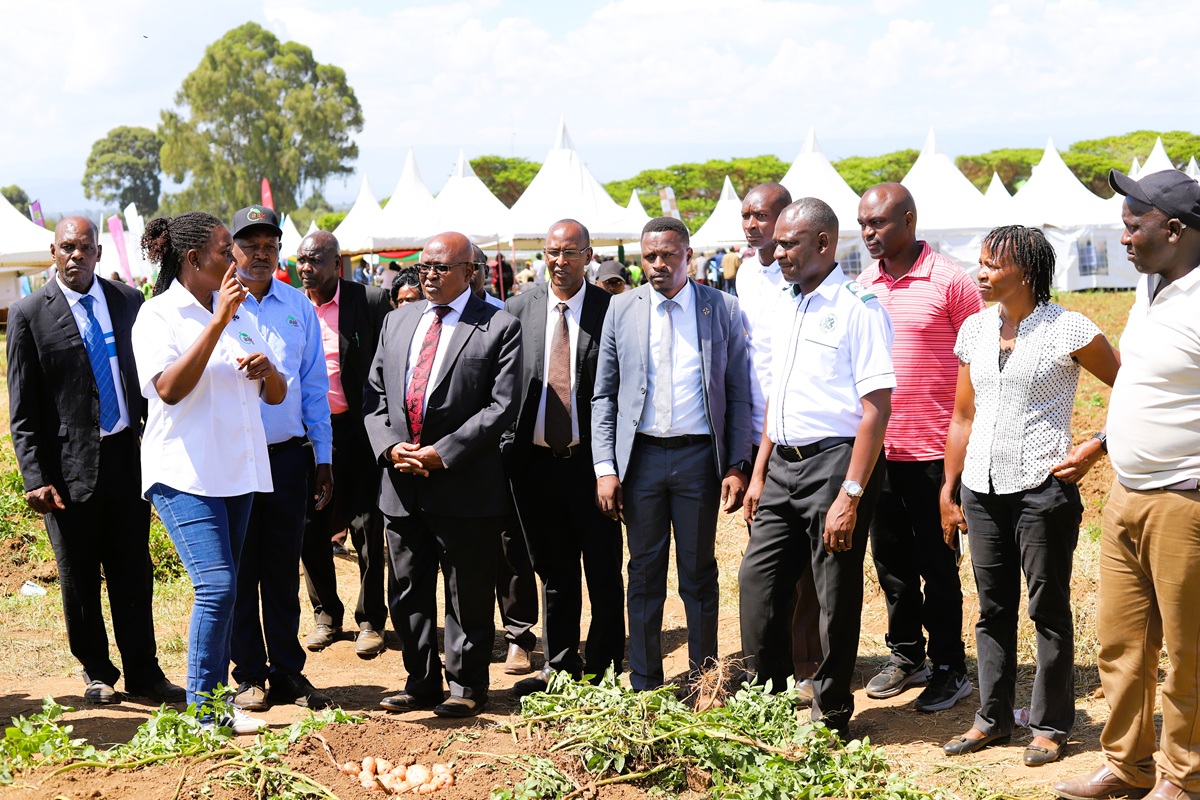
A Presidential Taskforce on coffee reform has reached out to Egerton University to establish a strategic partnership aimed at upgrading Kenya’s coffee value chain from production through to processing, value addition and marketing.
The proposal positions the University as a core science and research partner for a national bid to reverse declining productivity and raise export volumes from approximately 50 metric tonnes to a targeted 170 metric tonnes annually.
Officials say the partnership is expected to focus on breeder seed systems, nursery and seedling production, scientific husbandry practices, soil diagnostics, and commercialization pathways that link research outputs to coffee-producing co-operatives.

“We seek to revive coffee through co-operatives. Thus, Egerton University is seen as a strategic partner that will link with co-operatives to spur growth in Nakuru County and its environments,” said the Chairman of the Taskforce during an engagement held at the institution.
He further noted that the neighboring Baringo County, historically outside the crop’s production belt, is among the new frontier regions targeted for coffee expansion.
The Taskforce—established by the Executive—has a mandate to conduct a comprehensive review of the country’s coffee value chain and identify structural gaps requiring legislative, administrative, scientific and market interventions. Its review scope includes evaluating the crop’s enabling environment, institutional architecture, and policy alignment across county and national programmes. Coffee value chain reform has been elevated as a government priority given the sector’s export potential, contribution to rural incomes, and role in regional agro-processing strategies.
Officials emphasized that universities and research institutions offer leverage points unavailable to traditional commercial actors, particularly in cultivar development, agronomy, biosafety regulation, and downstream consumer research.
The Chairman said the Presidential directives seek to ensure that reforms “create lasting impact and connection with the populace” through linkages with institutions of higher learning.
Egerton University’s Vice Chancellor, Professor Isaac Kibwage, was singled out as a strategic interlocutor given his roots in Kisii, a coffee-growing region, and his leadership in agricultural research. “So, this is a person whom we can work with since he believes in the crop,” the Chairman noted.

One of the proposed programmes is value addition, encompassing roasting, grinding, packaging and branding. The Taskforce has floated the concept of “Egerton Coffee” as a branded product to support quality differentiation, job creation and industrial growth in coffee-producing counties. Officials argue that Kenya’s global reputation for specialty coffee remains inadequately monetized due to limited domestic processing and dependence on green bean exports.

Professor Gesimba Morwani, who initiated the engagement between the University and government agencies, underscored Egerton’s advantage as a registered seed producer and merchant. He argued that the model could be replicated for coffee seedlings to close a national shortage of approximately 50 million seedlings. With average yields estimated at two kilograms per tree and demand projections indicating a need to scale to roughly 13.6 million trees by 2030, seed systems were described as the “bottleneck variable” in production economics. “The University coming in to produce seedlings will be a game changer. We seek to make Kenya the largest coffee producer and exporter in the region. Currently, Ethiopia is the largest producer, and Uganda leads in export,” Morwani said.

The programme will be anchored in Egerton’s Department of Crops, Horticulture and Soils. University officials reiterated that its biosafety protocols discourage the use of compounds such as Ethidium Bromide, Mercury Chloride and Mercaptoethanol due to toxicity and disease prevention concerns. Compatibility between university-grade biosafety and phytosanitary standards is expected to enhance the credibility of planting materials destined for commercial nurseries.
Alongside production reforms, the Taskforce is examining digital sales systems (DSS) to streamline marketing and ensure consistent cash flow to farmers. The New Kenya Coffee Planters Union intends to expand into milling and marketing functions to strengthen co-operative control over high-value downstream activities.
Officials confirmed that a national launch for coffee production initiatives will take place in Murang’a County later this year. They also acknowledged that negative publicity, governance disputes and volatile markets weakened farmer confidence in past decades, though middle-class investors are now revisiting coffee farming as an income-generating venture.
By Kurian Musa, Communications Officer, Egerton University.
For inquiries:
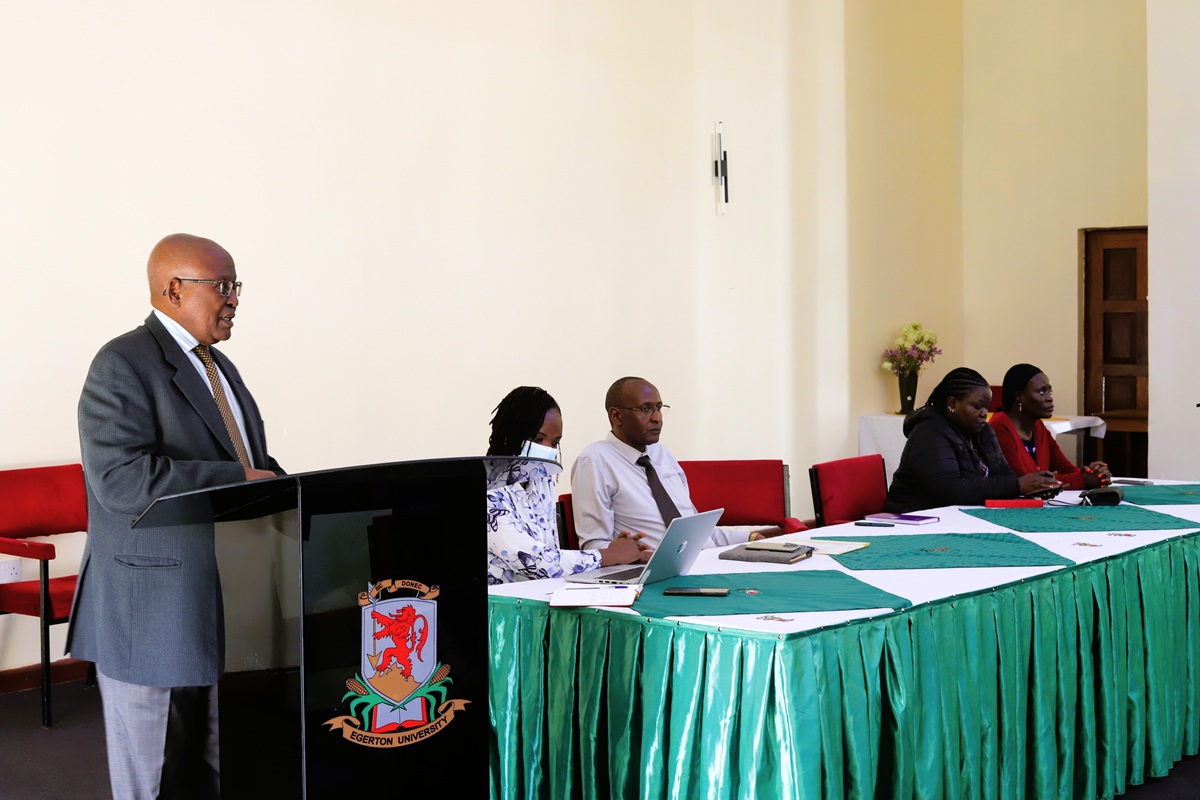
Egerton University is solidifying its position as a regional leader in agricultural innovation following a high-level meeting on Monday between Vice-Chancellor Prof. Isaac Kibwage and Kilimo Trust Kenya Country Director Mr. Antony Mugambi.
The engagement advanced plans for establishing a Joint Centre of Excellence in Regenerative Agriculture to be hosted at the university’s Agro-Science Park.
According to Director Agro-Science Park, Prof. Paul Kipkemboi Kimurto, the proposed Centre—valued at approximately KSh 30 million—is currently undergoing internal and inter-agency approvals and is expected to be launched soon once statutory and institutional processes are completed.
The facility is intended to drive research, innovation, and capacity development in sustainable and climate-smart food systems.
Prof. Kimurto, who led technical discussions with Kilimo Trust officials, emphasized that the Centre will anchor demonstration farms, farmer and extension training, agribusiness incubation, and collaborative applied research.
The initiative aligns with Egerton University’s core mandate in agricultural science and will enhance the Agro-Science Park’s role as a regional hub for regenerative agriculture, value chain development, and technology transfer.
The project is to be financed through a joint proposal by the Agro-Science Park and Kilimo Trust to the IKEA Foundation (Netherlands).
Prof. Kimurto noted that the Foundation is currently supporting complementary work on regenerative rice technologies—such as biochar production, rice straw valorization for livestock feed, and legume integration in Mwea and Ahero irrigation schemes—implemented jointly by Egerton University and Kilimo Trust.
Lead scientists include Prof. Kimurto and Prof. Ondiek (Chair, Animal Science), with several postgraduate students (MSc and PhD) contributing to field experimentation and data generation.
Speaking during the meeting, Kilimo Trust Country Director Mr. Antony Mugambi stated that the Joint Centre of Excellence will serve as a regional platform for East Africa dedicated to climate-smart agriculture, carbon-credit and bio-economy research, and private sector innovation within regenerative agriculture and agrifood systems.
On behalf of the Kilimo Trust Board and CEO Dr. Birungi Kurutaro, based in Kampala, Uganda, Mr. Mugambi expressed appreciation to the Vice-Chancellor and university management for facilitating approvals through the National Treasury, Ministry of Education, and Attorney General’s Office.
Mugambi affirmed that the Centre will be accessible to researchers, students, and agricultural communities.
Vice-Chancellor Prof. Kibwage welcomed the partnership, noting that the Centre aligns with national and continental priorities in sustainable food systems and demonstrates the university’s commitment to knowledge-driven agricultural transformation.
The initiative signals an enhanced model of university–industry–development collaboration, with potential to influence policy, improve farmer resilience, and strengthen value chains amid accelerating climate variability in the region.
^Km