


The Chief Guest, Distinguished Guests, Members of the Egerton University Community, and Friends of Egerton University!
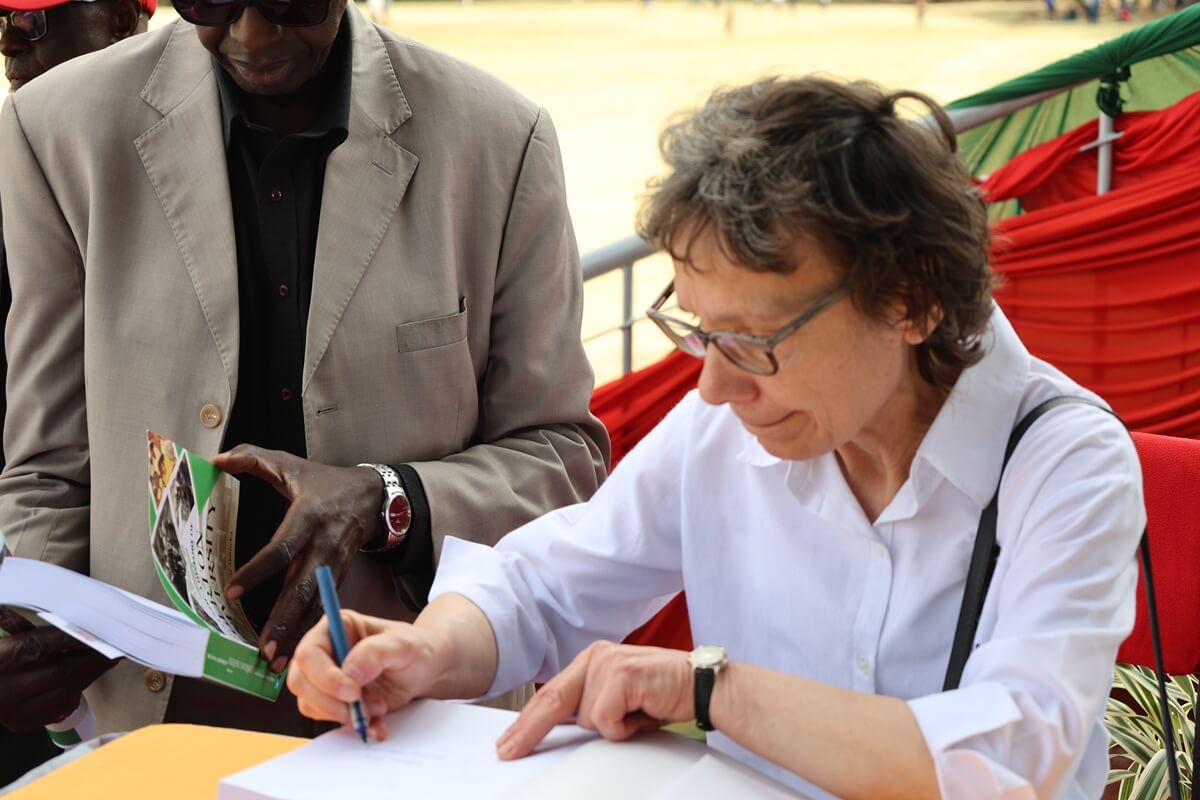
The book Thus Until: A History of Egerton University, 1939–2019 was initially, rather unrealistically, meant to be written in time for the 75th anniversary of Egerton University. It didn’t happen. Then, the 80th anniversary was targeted. Again, it wasn’t possible. We finally made it for the 85th anniversary. And the launch takes place today, when we mark 86 years of the founding of the University. But what are anniversaries?
One thing that the ten years of work on the book has taught us is that it is not the mere passage of time that makes history and is, therefore, worthy of celebration. Rather, it is the weight of things that matters: the significance and relevance of what people do, the magnitude of their actions, the genuineness of effort, the thoughtfulness and hard work of human beings. It is these that pass through the sieve of judgement and become history. Egerton’s history is woven with such meaningfulness and, in truth, with greatness. Thus Until is the unembellished record of the facts. That is why it took long days to construct it. That is why it is vital to have that history, and – now that we have it – to live by it, to incorporate our knowledge of it in our lives in the present.
That is the other point, that we cannot live meaningfully in the present without knowing our history. We are rootless without history. However rich the present moment is, or seems to be, it is only but a fragment of the vast tapestry of life. And to imagine that a fragment is the whole is to diminish our lives, and, what is worse, to diminish the possibilities of making Egerton thrive into eternity. It would be a travesty of the idea that the university as an institution is a citadel of knowledge, if, out of wilful ignorance, we continued to repeat and believe in half-truths and false stories (like that of the three students with whom the institution started or of Lord Egerton having been a misogynist, of women having been banned from Egeton School during his time).
Another related point is that we need to have a true measure of the significance of our past. Thus, we have not made full sense of the fact that there is one way in which Egerton is unique in the whole of Africa. All other universities on the continent started either as university colleges created by colonial governments for small African elites or as national universities established by independent African governments. Egerton is the only one which began as an agricultural school/later college for white settlers, shutting its door to the African people of Kenya. It was deliberately meant not to be what it became and what it is today. This means that the Egerton University of independent Kenya had to undertake a transformation that no other university has had to deal with. The whole complex of tasks, way of thinking and rebuilding that its pioneers invested in this transformation constitutes an experience that is unmatched in its wealth. Again, it is only through the careful study of our history that we would be able to benefit from this experience.
In addition, one of the most inspiring discoveries of our work was how much the outside world values the rich history of Egerton University and respects the University on account of it. This realisation came in the course of the massive support we received for the project. Just to give a few examples. The management of Tatton Park in the United Kingdom went to extraordinary lengths to avail information on Maurice Egerton, especially through the digitalisation of his 103 diaries for our use; they also enabled our access to the Tatton Park Archive and the Cheshire Record Office where photographs, correspondence, and other documents pertaining to Lord Egerton’s life were kept. Similar help came from the Knutsford Library, and the office of the Knutsford Guardian. The Museum of English Rural Life and University of Reading Special Collections, the Cambridge University Library, the Bodleian Library, the British Library, the United Nations Library at Geneva, the Wageningen University & Research Library, and the USAID Library provided vital documents, going far beyond the call of duty and often offering more than we had asked for. We acknowledge the support we received form these institutions.
The most significant support, however, came from withing Egerton University itself. Prof. Njenga Munene, as has already been said, gave the idea and the first impetus to the project; while Prof. Chris Onyango helped us understand what our task involved and led us along the only paths that would reach people and institutions; Prof. Ezra Maririm and Prof. James Tuitoek encouraged us to think that what we were doing was the most important thing in the world. The University Library, and especially its archivists, opened up the treasure trove of documents whose existence had for long been unknown even to themselves. Many former and current colleagues – from the administration, the support staff, and the academic staff – provided significant information about various aspects of the life of Egerton College and Egerton University. It was amazing how everybody knew something that was new and added to our understanding. This was particularly true of the staff who were there in the early years of the College. Some of them were in frail health, reaching the end of their lives, but not one declined to assist and everyone was generous almost to a fault. Sadly, a number of the 57 individuals who gave us interviews – from carpenters, to cleaners, to lecturers, to top administrators – are not with us to share this moment which they would have cherished. We pay tribute to them today.
The Management of the University was supportive all through. The intellectual and administrative support we received from the Vice-Chancellor, Prof. Isaac Kibwage, was unparalleled. Every word he said, every action he initiated, every decision he took was crucial to the successful outcome of our work. The trust and confidence bestowed on us was absolute. We were given unrestricted access to all existing documentation in the University. There was also not a single instance of censorship of any kind.
The wisdom and professionalism of East African Educational Publishers – the publisher of Thus Until – confirmed the truth that the collaboration between authors and a great publisher is what makes scholarship succeed.
Finally, we are encouraged that the book is receiving positive responses. It has so far been reviewed by the Saturday Nation and the Old Africa magazine. Top-notch academic journals have asked the publisher for review copies. These include African Studies Quarterly, Journal of Modern African Studies, Higer Education, and Comparative Education Review. It has drawn the attention of prominent historians like Prof. Dane Kennedy and Prof. Charles Hornsby. It has already found its place in libraries of overseas universities like the Library of the University of California, Berkeley.
This is all.
I thank everyone for being here today!