


Four student innovators demonstrate how investment in entrepreneurship training, mentorship and innovation development can unlock homegrown solutions to challenges in food security, health, education and climate change.
What happens when young people are given the skills, mentorship and opportunity to turn their ideas into solutions for society's most pressing challenges? At Egerton University, the answer is increasingly visible in the innovations emerging from its students.
Four Egerton University (EU) students recently took this promise to the national innovation stage, earning places among the finalists at the Campus Spark Hackathon held in Nairobi on October 29–30.
Their innovations, spanning agriculture and food security, health and wellbeing, digital transformation and artificial intelligence, and climate action, offer a glimpse into the potential of student-led research and creativity to address real-world development challenges.
Organized by the Network of Entrepreneurial Institutions Leaders (NEIL), the two-day hackathon brought together emerging innovators to showcase ideas, develop solutions and engage with the wider entrepreneurship and industry ecosystem.
For the four students, reaching the finals was more than a competition milestone. It was an opportunity to test their ideas, communicate their value, receive exposure beyond the university environment and connect with people and networks that could help move their innovations closer to practical application.
Four ideas. Four development challenges. One shared ambition.
Representing the Agriculture and Food Security category, Risper Olang presented Vertical Victory Gardens, an innovation focused on the potential of vertical gardening to contribute to food production and food security.
In the Health and Wellbeing category, Brooklyn Simiyu showcased Probiotic Enriched Indigenous African Herbal Tea, an innovation that brings together indigenous African herbal knowledge and probiotic enrichment, exploring opportunities at the intersection of local resources, food innovation and wellbeing.
Laurette Achieng Omondi represented the Digital Transformation and AI category with STEMHER Quest, an innovation whose focus on STEM and digital engagement speaks to the importance of expanding opportunities for participation in science, technology, engineering and mathematics.
Meanwhile, in the Climate Action and Green category, George Odhiambo presented Clean Bio Fuel, an innovation aligned with the search for cleaner and more sustainable energy alternatives.
Although different in focus, the four innovations share a common thread: the desire to translate ideas into solutions that respond to societal needs. They also demonstrate the value of nurturing innovation across disciplines and encouraging students to view their knowledge not only as an academic achievement but also as a resource for solving practical problems.
The power of investing in the innovation journey
Behind the students' achievement is a process of learning, experimentation, mentorship and exposure.
The students have benefited significantly from boot camp training and related capacity-building engagements that have equipped them with practical skills in innovation development, pitching and networking with industry players. These experiences have helped them refine their ideas, articulate the problems they seek to address and appreciate the pathways through which innovations can progress from concept to potential application.
Their experience illustrates an important dimension of university-based innovation: promising ideas need more than technical knowledge to succeed. They require an enabling ecosystem that provides mentorship, opportunities for validation, access to networks, entrepreneurial skills and linkages to potential collaborators and investors.
It is this connection between knowledge creation and real-world application that makes investment in innovation training and technology transfer particularly important.
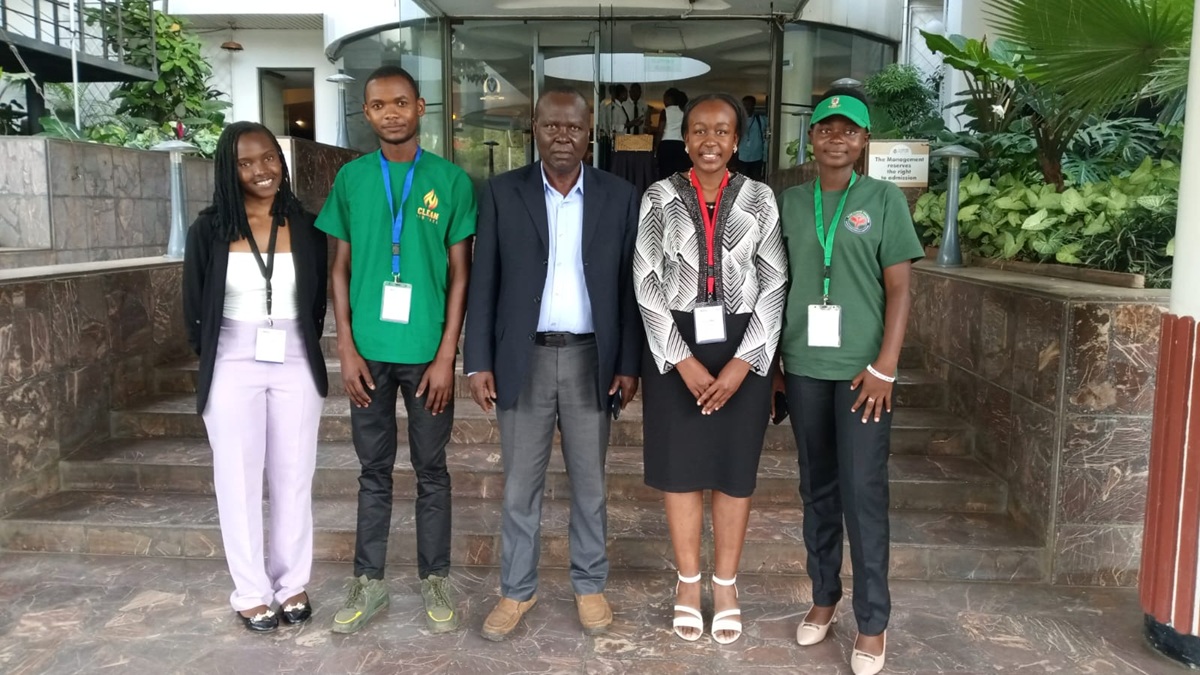
Pictured with the four finalists is Egerton University's Technology Transfer Manager, Dr. Joseph S. Momanyi, whose work supports the university's innovation and technology transfer agenda.
The students' achievement reinforces the importance of sustained institutional support in building an innovation pipeline that identifies promising ideas, strengthens their development and creates opportunities for engagement with industry and other innovation ecosystem actors.
A case for strengthening university–industry–development partnerships
For the research and development community, the four innovations represent more than student projects. They point to opportunities for further research, interdisciplinary collaboration, product development, testing, validation and potential commercialization.
For development partners and donors, their journey underscores the value of investing in the people, skills and institutional structures that enable innovation to thrive.
Support for boot camps, mentorship, prototyping, research translation, intellectual property management and industry engagement can help bridge the gap between promising ideas and solutions capable of delivering measurable societal benefits.
The next step is to build on this momentum by creating opportunities for the students to further develop and validate their innovations, connect with relevant technical experts, access resources and engage potential implementation and investment partners.
As universities increasingly embrace their role as drivers of innovation and socio-economic transformation, stories such as these demonstrate why nurturing young innovators matters.
At Egerton University, these four students are showing what is possible when creativity meets opportunity, and when academic learning is supported by practical innovation training and exposure.
This is a testament that some of tomorrow's solutions to Africa's development challenges may already be taking shape in university classrooms, laboratories and innovation spaces. What they need is the right ecosystem to grow.
Egerton University congratulates Risper Olang, Brooklyn Simiyu, Laurette Achieng Omondi and George Odhiambo for representing the University at the Campus Spark Hackathon finals and contributing to a growing culture of student-led innovation.
By Musa Kurian / Communication Officer Egerton University