



By Kurian Musa
Egerton University on Wednesday, August 26, 2026, hosted a delegation of professors and students from Shanghai Jiao Tong University (SJTU), China, for discussions on strengthening collaboration in sustainable agriculture, renewable energy and innovative technologies for smallholder farmers.
The visit, organised at the invitation of Professor Paul Kimurto and Dr Stephen Githeng’u of the Department of Crops, Horticulture and Soils, brought together three SJTU professors and eight students drawn from different colleges within the Chinese university.
The delegation included Professor Huang Danfeng from the School of Agriculture, an expert in smart facility agriculture and vegetable cultivation; Professor Du Hongmei from the School of Design, whose work focuses on horticulture, particularly flower cultivation and processing; and Professor Hu Yue, who specialises in power equipment condition monitoring and the development and application of agriculture-energy integration systems.
The visit formed part of SJTU’s Global Challenge Program, a platform that enables students to engage with international development challenges and develop practical solutions through interdisciplinary collaboration. The “Sunrise East” team, which focuses on sustainable agriculture and energy solutions, seeks to combine engineering and innovative design to develop affordable technologies for farming communities in developing countries.
The team’s interest in Kenya is particularly informed by the country’s abundant renewable energy resources, including solar and geothermal energy, and the opportunities to apply these resources to agricultural production.
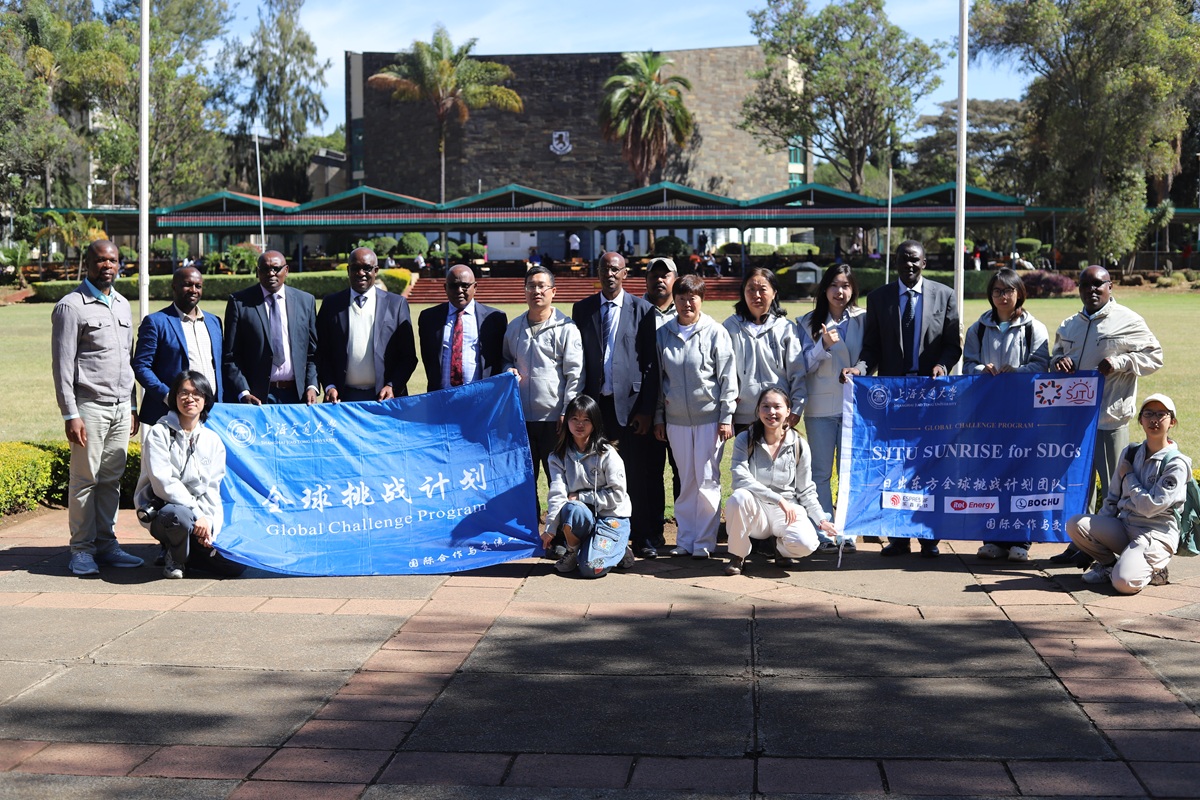
The delegation also paid a courtesy call on Egerton University Vice-Chancellor Prof. Isaac Kibwage, where discussions focused on strengthening institutional collaboration and advancing the proposed agriculture-energy initiatives. Prof. Kibwage welcomed the delegation and shared light moments with the visitors as they discussed opportunities for deeper engagement between the two universities.
Prof. Kibwage emphasised that the partnership should place research and innovation at the centre, with a focus on developing joint grant proposals, creating practical products and technologies, and taking promising innovations through commercialisation. He pointed to the Agro-Science Park as an important platform through which research outputs can be developed, tested and transformed into products with potential for market uptake and wider community benefit.
Also present during the courtesy call were Deputy Vice-Chancellor (Academics, Research and Extension) Prof. Bernard O. Aduda and Deputy Vice-Chancellor (Administration, Finance and Planning) Prof. George Mungiria Muthaa.
The two Deputy Vice-Chancellors welcomed the SJTU delegation and expressed gratitude for the visit, noting the importance of international partnerships in advancing the University’s research, innovation and development agenda.
They supported the proposals for joint research, grant development and product commercialisation, and encouraged the two institutions to identify concrete areas of collaboration that can deliver tangible benefits to farmers and communities. Egerton University’s official management listing identifies Prof. Aduda and Prof. Muthaa as the respective holders of the two Deputy Vice-Chancellor positions.
Discussions highlighted post-harvest losses and inadequate cold-chain infrastructure as significant challenges facing smallholder farmers. Fresh products such as milk, fruits and vegetables require appropriate cooling and storage to maintain quality and reduce losses that directly affect farmers’ incomes.
The two institutions identified opportunities for developing tailor-made, portable, small-capacity solar-powered cold boxes for use by dairy farmers at the farm level. For crop producers, vehicle-mounted solar cold-storage units could facilitate rapid pre-cooling immediately after harvesting.
Another proposed intervention was the establishment of community-based solar energy service centres that could provide cold storage while also supplying electricity for productive activities such as irrigation and agro-processing.
Such innovations, the discussions noted, could help farmers reduce post-harvest losses, improve productivity, enhance food quality and increase household incomes while promoting the use of clean energy.
During their visit, the SJTU delegation engaged Egerton University students and staff in a public lecture and toured the University’s Agro-Science Park. They also visited the China-Kenya Joint Laboratory on Crop Molecular Biology, providing an opportunity to explore areas for future research, innovation and academic collaboration.
The visit underscored the potential of international university partnerships to translate research and engineering innovations into practical solutions addressing real challenges facing farming communities.